
ADVERTISEMENT
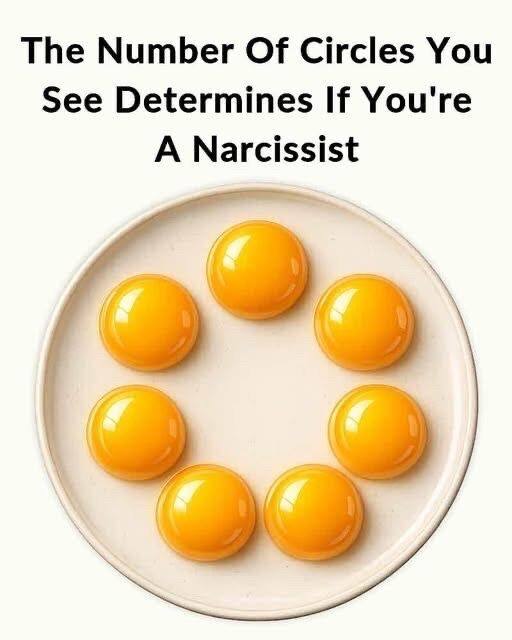
You’ve probably seen it before—a simple image asking, “How many circles do you see?”
Some versions go even further, claiming your answer can reveal whether you’re narcissistic, intuitive, or highly intelligent. That sounds intriguing, but it’s also misleading.
These viral tests are designed to be engaging and shareable, not scientifically accurate. Still, they can offer something interesting: a glimpse into how attention, perception, and thinking styles differ from one person to another.
Seeing More Than the Obvious
People who identify eight or nine circles often go beyond the most visible elements. They don’t just focus on the main shapes. Instead, they include surrounding context—like the plate or even the empty space at the center.
This reflects a broader way of thinking.
These individuals tend to:
- Look at relationships between elements
- Notice structure and context
- Interpret both visible and invisible forms
Recognizing empty space as a shape is especially interesting. It shows sensitivity to what is known as negative space—a concept commonly used in art and design.
Rather than asking “What is this?”, these people often think:
“How does everything connect?”
In everyday life, this mindset can support:
- Better awareness of social dynamics
- Stronger empathy
- A more strategic way of thinking
That said, this doesn’t mean they are “more intuitive” or “deeper” than others. It simply reflects a different way of organizing information.
When Detail Becomes the Focus
Those who see ten or more circles usually go even further.
They may count:
- Reflections
- Highlights
- Shadows
- Outlines
- Implied or hidden shapes
This suggests a more analytical and detail-oriented thinking style.
These individuals often:
- Break things down into smaller parts
- Explore multiple interpretations
- Question first impressions
In problem-solving situations, this can be a real strength. It supports careful observation and independent thinking, which are valuable in many fields.
However, there is also a potential downside.
Focusing on too many details can sometimes lead to:
- Overthinking
- Difficulty making decisions
- Mental fatigue
Being confident in your own interpretation is not narcissism. Real narcissism is a complex psychological trait involving patterns like lack of empathy and excessive self-focus. It cannot be identified through a simple visual puzzle.
What this group actually shows is curiosity and a willingness to explore beyond the surface.
— See Next Page —
ADVERTISEMENT
